
Understanding Fed Rate Cuts: A Guide for Long-Term Investors

K. Brad Tedrick, CFA®, CFP®
The famous investing principle “don’t fight the Fed” was coined in the 1970s but has only grown in significance. The idea is simple: the Federal Reserve’s monetary policy decisions can have important effects on markets and the economy, so investors should consider them carefully. At the same time, perspective is needed to focus on the overall path of interest rates, and not individual Fed decisions. This is relevant today as the Fed continues its rate-cutting cycle amid a complex economic environment.
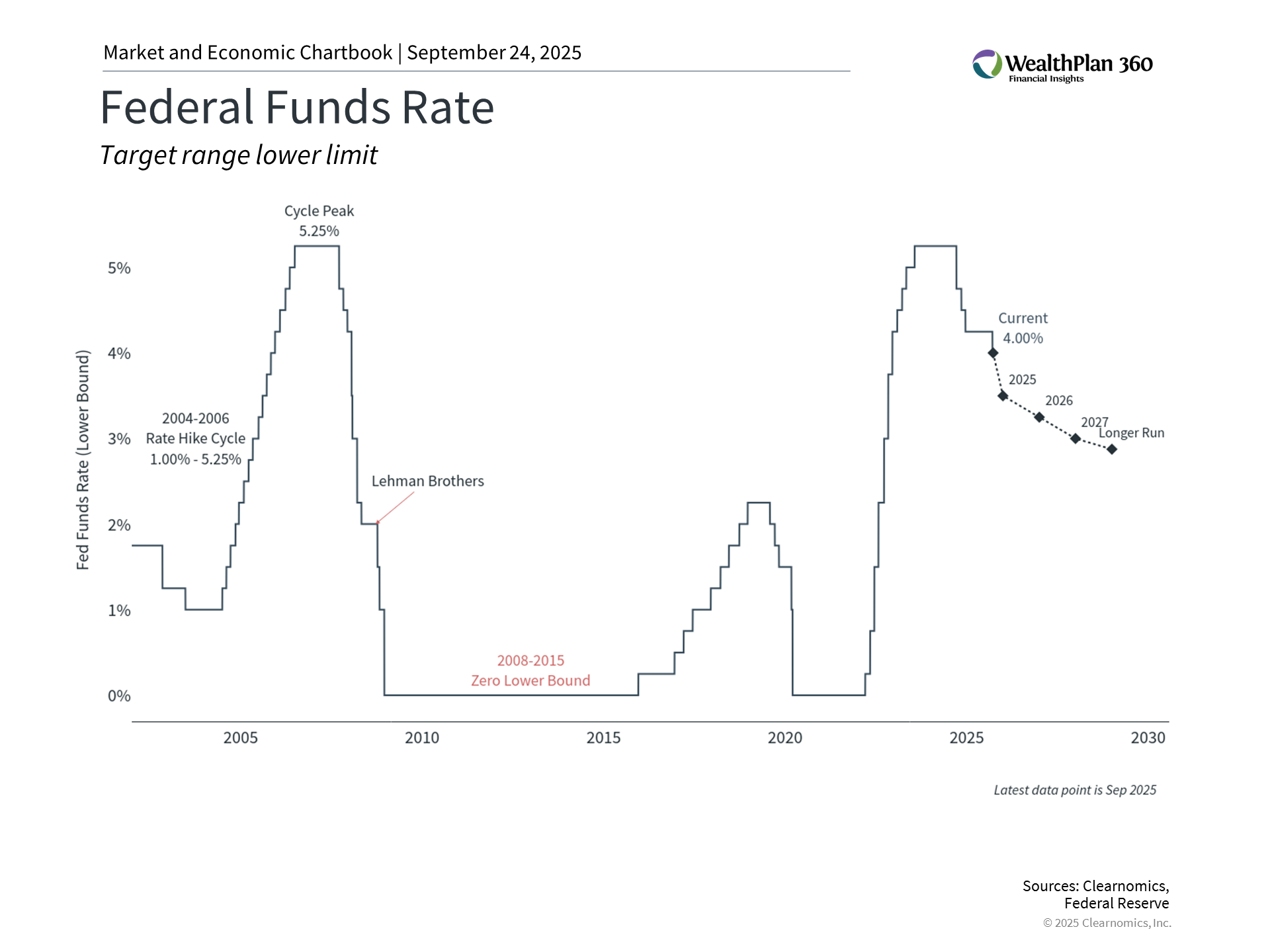
As was widely expected, the Fed cut policy rates by 0.25% at its September meeting, continuing the easing cycle that first began in 2024. This decision came at a time when markets are near all-time highs, economic signals are mixed, and there is still uncertainty around tariffs and inflation. Unlike the emergency rate cuts during the 2008 global financial crisis or the 2020 pandemic, today’s move is an attempt by the Fed to fine-tune policy to sustain growth, rather than responding to a crisis.
For long-term investors, understanding why the Fed is cutting rates and how this environment differs from previous cycles can provide important context for financial planning and portfolio decisions. While rate cuts generally support financial markets, the key is maintaining perspective and staying focused on long-term financial goals rather than overreacting to each policy change.
“Why” the Fed is cutting rates matters more than “when” or “how much”
 |
In making its policy decisions, Fed officials study economic data including growth, jobs, and inflation to form an outlook. When the outlook is hazy, it’s natural for Fed officials and other economists to not see eye-to-eye, resulting in differing views on the path and size of upcoming rate cuts. This is the case today with wide dispersion among officials’ rate forecasts. While many headlines are focusing on the political battles between the Fed and the White House, the truth is that there has been a divergence all along.
Despite this disagreement, it’s important to keep a few facts in mind. First, the Fed had been anticipating that it would cut rates for quite some time. Each of the recently published Summary of Economic Projections showed that rate cuts were likely to begin this year, even if the number and magnitude have varied based on tariff news and market swings. The Fed’s latest projections show there could be two additional cuts this year, with an improved growth outlook.
Second, the latest rate cut is fundamentally different from historical cutting cycles that were mostly driven by emergencies. Today’s rate cuts continue to reverse the rapid increase in rates in response to inflation that began in 2022. They also occur against a softening but positive economic backdrop, even if the jobs data is potentially weakening and inflation is more stubborn than expected. In other words, the Fed cutting rates by one-quarter of one percent to help steer the economy is distinct from large emergency cuts due to problems with the financial system or an economic crisis.
Third, Fed Chair Jerome Powell’s term will most likely end in May 2026. The next Fed governor will be appointed by President Trump, which means the most likely path of the federal funds rate will be lower. While this could mean that short-term interest rates will likely trend lower as well, it’s important to remember that long-term interest rates are driven by market and economic forces, not Fed policy. For example, if lower short-term rates were to drive inflation higher, this might unintentionally result in higher long-term rates.
So, while this rate cut represents the Fed continuing its trajectory from 2024, rather than a complete shift in direction, it also signals the Fed’s commitment to supporting economic expansion.
Recent economic data has been mixed
 |
A primary driver of the Fed’s decision was softening in the labor market. The economy added only 22,000 jobs in August, well below expectations, and previous months’ numbers were revised down significantly. The unemployment rate only ticked up to 4.3%, however, due to fewer workers seeking jobs. Once again, this is different from past emergency rate cut periods. During the 2008 financial crisis, unemployment spiked from 5.0% to 10.0% and in 2020, it jumped from 3.5% to 14.8%. Today, the jobs numbers suggest a more gradual cooling that may reflect a softening of labor market conditions.
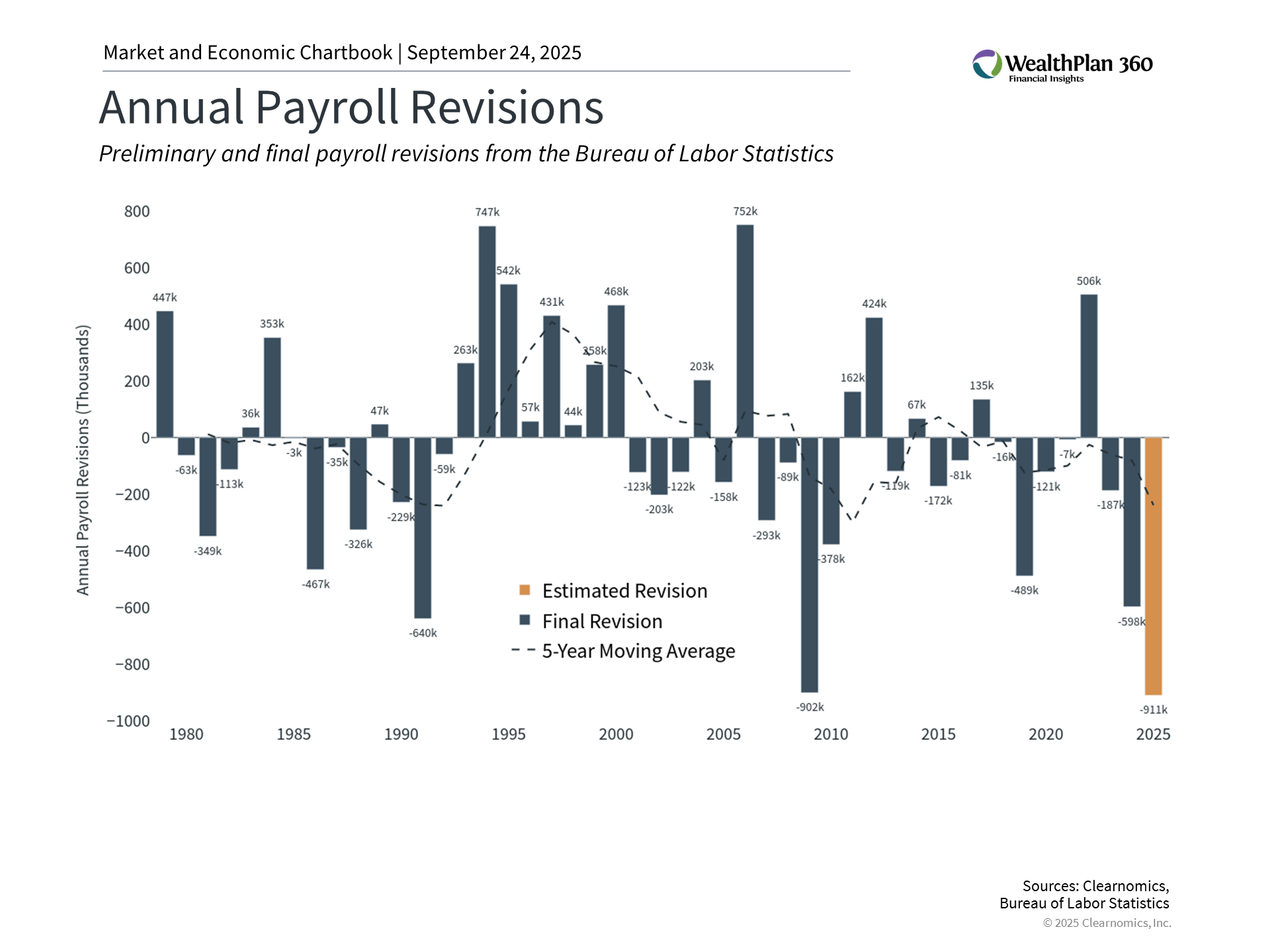
Adding to concerns about labor market weakening, recent payroll revisions have painted a more subdued picture of recent job growth than previous data indicated. The Bureau of Labor Statistics’ annual revision process showed 911,000 fewer new jobs were created from March 2024 to March 2025, suggesting the labor market was cooling more rapidly than policymakers realized when making earlier monetary policy decisions. These are preliminary estimates that will be finalized in early 2026.
While a weakening labor market would support lowering interest rates, the Fed’s concerns around inflation support keeping rates steady, or even raising them if tariffs drive prices higher. The Fed’s preferred inflation gauge, the Personal Consumption Expenditures (PCE) Price Index, at 2.6%, remains well above the 2% target. Core PCE is hovering at 2.9%, while headline and core CPI have remained sticky at 2.9% and 3.1%, respectively. Earlier progress on inflation has not only slowed, but some of the trends have reversed in recent months.
The Fed’s job is to balance these factors as part of its “dual mandate.” The mixed signals these indicators are sending explain why there is disagreement both within the Fed and with the White House. For investors, understanding these trends will likely be more helpful in understanding the economic and interest rate environment than watching the day-to-day political headlines.
Rate cuts generally benefit businesses and investors
For investors, the critical distinction is whether rate cuts coincide with recession or support continued expansion. While there are some signs of economic weakness, there are not yet signs of a recession. In these situations, rate cuts typically provide broad benefits across financial markets. Lower borrowing costs make it cheaper for companies to finance growth and reduce debt service expenses. Consumer spending can increase if mortgage and credit card rates decline, boosting demand for goods and services.
One concern with rate cuts today is that the stock market is already near all-time highs. While this is not typical, there have been historical cases during which this occurred. For example, under Alan Greenspan, the Fed cut rates three times in 1995 and 1996, calling the cuts “insurance” against economic slowdown. The Fed also made cuts in 2019 at market highs to address global growth concerns. At the latest press conference, Powell described this most recent policy decision as “a risk management cut” due to the Fed’s view that “downside risks to employment have risen.”
For portfolios, history shows that the effects of rate cuts are generally positive across asset classes. While the past is no guarantee of the future, stocks typically benefit as lower rates reduce the discount rate for future earnings and improve corporate profitability, especially among growth-oriented businesses. Meanwhile, bonds typically become more valuable due to their higher rates, although this can vary across bond sectors and maturities. In contrast, cash will likely experience lower yields, making it even less attractive compared to investments like stocks and bonds.
While each economic cycle is unique, navigating policy change is a normal part of investing. Importantly, rate cuts are generally supportive for long-term investors, although balancing risk and reward requires a broad understanding of market trends.
The bottom line? The Fed’s latest rate cut may support the economy amid mixed signals. Investors should maintain a long-term perspective, focusing on the overall market direction rather than individual Fed decisions.


